

While the level of carbon dioxide (CO2) in Earth’s atmosphere has increased rapidly over the past century due to human activity, more than 100 parts per million (ppm) in just five decades, the level of CO2 we breath daily in our homes, at work or school, churches or any indoor space is often 1500-2500 parts per million (ppm). A space craft is more tightly sealed than most any building on Earth (for obvious reasons). Therefore, the CO2 generated by the crew members must be actively mitigated.
While there is active research and debate for the effects of CO2 at various levels, the International Space Station ran at 5000 ppm for nearly twenty years, and U.S. Navy submarines are known to operate at 10,000 ppm for periods of time. The ISS is now working to keep CO2 at 3500 ppm, and at SAM we maintain 2500-3500 ppm for our crewed missions, depending on the Mode of Operation, bioregeneration or physico-chemical mitigation, and the crew’s own preferences.
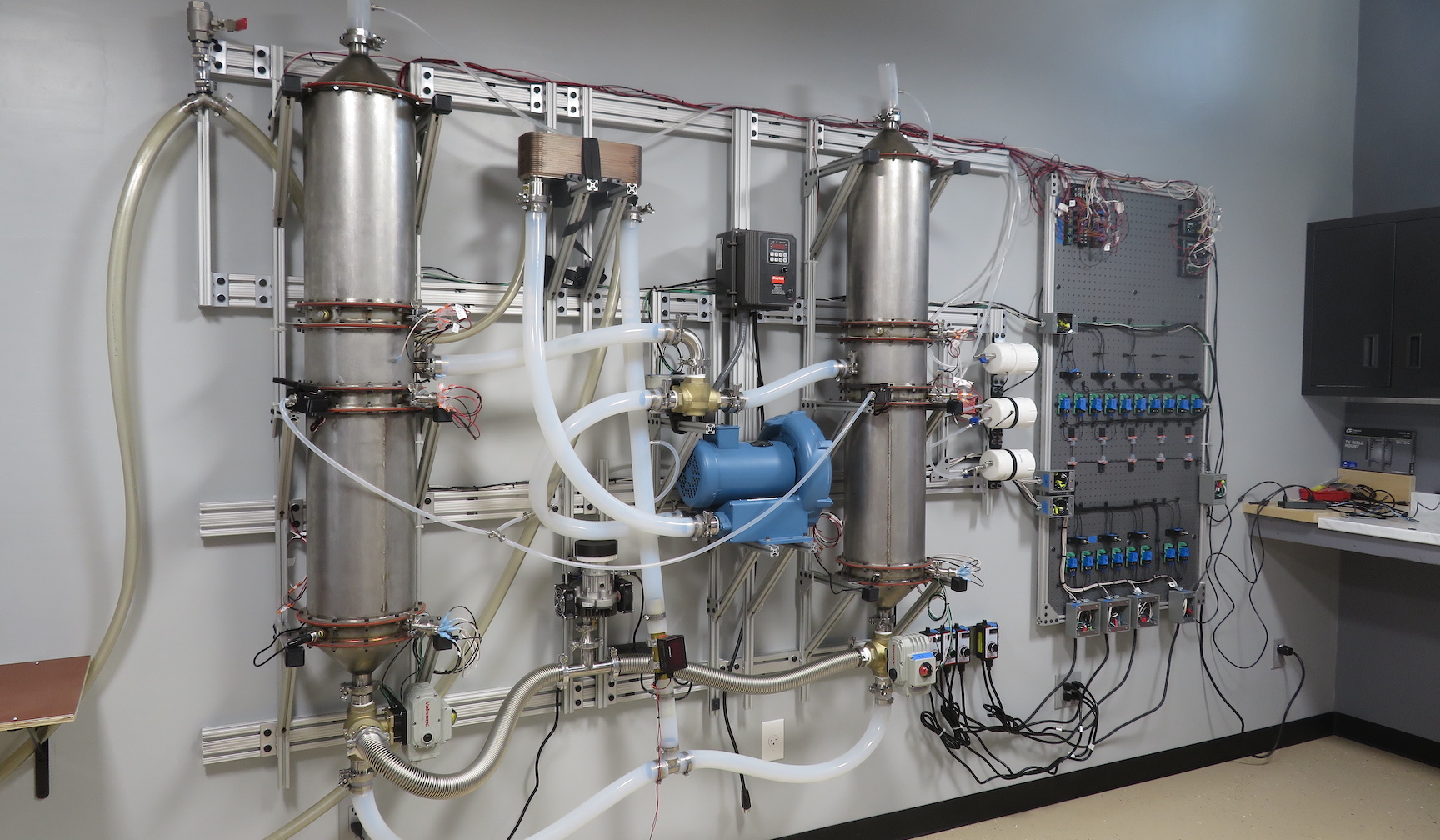
While a single-use, non-regenerable CO2 removal system are often employed on short duration space flights (ie. SpaceX Crew Dragon or the Boeing Starliner) these are not well suited for long-duration missions as the mass of sorbent (the chemical used to capture the CO2 becomes prohibitive. Therefore, we built a regenerable, 4-bed-CO2 removal system (4BCO2) at SAM.
The SAM 4BCO2 is able to capture (adsorb) and release (desorb) CO2 on a routine cycle. This type of system is in use on the International Space Station (ISS) and is planned for future space stations and long-duration crewed missions. SAM licensed the technology employed in its CO2 scrubber from NASA Marshall, and had enjoyed the honor of working with Dr. James Knox, NASA veteran of nearly three decades and renowned expert on carbon dioxide removal systems.
The 4BCO2 system employs a “4-bed, molecular sieve, thermal-vacuum, swing adsorption cycle”. Let’s break that down. 4-bed simply means there are four main metal chambers, two of which contain silica desiccants, and two of which contain zeolites. Both are good at capturing water vapor, so we must remove the water vapor using the silica before the air arrives to the zeolites, else the water vapor will saturate the eager zeolite molecules, leaving little room for carbon dioxide. Thus, “molecular sieve”.
The machine cycles between modes of adsorbing (capture when cool) or desorbing (release when hot) both water vapor and CO2 based on the temperature and vacuum pressure applied. When the bed is desorbing, the CO2 is released to “space”, into a storage system, or into an experiment such as a photo-bioreactor (algae chamber). The water vapor can be captured or released back into the cabin, depending on the desired relative humidity. This entire process switches every half cycle, such that each of the fours canisters goes through an adsorb/desorb cycle (thus “swing”), over and over again. If properly configured and well maintained, a system can keep the air breathable and healthy for thousands of cycles.
Introduction | Design | Experiment | Components | Assemble | Fabrication | First Run